The Grapes of Wrath
Steinbeck's 1939 novel followed Dust Bowl migrants westward on Route 66 and gave the road its enduring name, 'the mother road'.
Loading
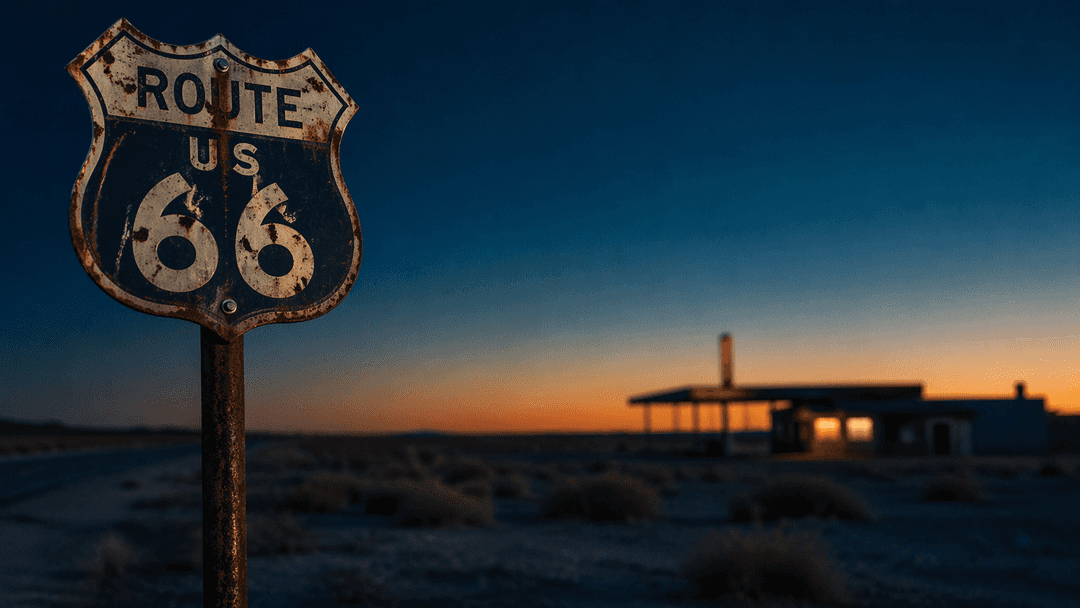
From a 1926 telegram in Springfield, Missouri to the centennial we're driving in 2026. The road, the people who named it, the songs that kept it alive, and what still stands.
April 30: U.S. Route 66 receives its number. November 11: officially commissioned. 2,448 miles, Chicago to Santa Monica, only 800 of them paved.
Avery, a Tulsa businessman who fought to bend the federal highway through Oklahoma, founds the U.S. Highway 66 Association and coins the byline 'The Main Street of America'.
Eleven years after the road was numbered, the last gravel and brick stretches are paved. Route 66 becomes the first transcontinental highway end-to-end on hard surface.
John Steinbeck calls it 'the mother road' in The Grapes of Wrath, the chapter on Dust Bowl migrants heading west. The name sticks for good.
'(Get Your Kicks on) Route 66'. Nat King Cole records it first; later Chuck Berry, the Rolling Stones, Depeche Mode. The road is now in the American Songbook.
President Eisenhower signs the Federal Highway Act. Over the next three decades, I-55, I-44, I-40, I-15, and I-10 will replace Route 66 mile by mile.
CBS airs Route 66, 116 episodes with Martin Milner and George Maharis in a Corvette. Most of it isn't filmed on the actual road, but the road's mythology hardens.
October 13: Williams becomes the last town on Route 66 bypassed by the interstate. The road is now functionally obsolete.
June 27: U.S. Route 66 is officially removed from the federal highway system. It exists only as memory and as the towns that refuse to let go.
The barber of Seligman, Arizona organizes Route 66's first state-level historic-preservation movement. Arizona designates 158 miles 'Historic Route 66'. The other states follow.
Pixar's Cars puts Route 66 back in the cultural foreground. The Cars team road-tripped the Mother Road in research; Galena, Kansas's lonely old tow truck became Tow Mater. Other Radiator Springs landmarks, the U-Drop Inn as Ramone's Body Shop, the Wagon Wheel as the Cozy Cone, the Rock Cafe as Sally, are widely credited by Route 66 communities though not all are officially confirmed by Pixar.
Congress passes the Route 66 Centennial Commission Act with representatives from all eight Route 66 states.
One hundred years. Roughly 85% of the original road is still drivable. More than 250 of its buildings, bridges, and alignments are listed on the National Register. The Mother Road Run is part of how this year is remembered.
A Tulsa businessman who ran a service station and chaired Oklahoma's State Highway Commission. When the federal government drew up the numbered highway system in 1925, Avery lobbied to bend the new road southwest through his state. He won, and Route 66 ran past his filling station.
In April 1926, Avery and Springfield, Missouri businessman John Woodruff are credited with proposing the name "Route 66" to the federal numbering committee, after Avery's preferred numbers (60, 62) had been taken. Avery's bronze likeness, with his family in a Model T, stands today on the Tulsa bridge that bears his name.
Steinbeck's 1939 novel followed Dust Bowl migrants westward on Route 66 and gave the road its enduring name, 'the mother road'.
Bobby Troup wrote it on a westward drive in 1946. Nat King Cole's recording made it a standard. Hundreds of artists have covered it since.
Martin Milner and George Maharis driving a Corvette through 25 states, mostly not the actual road, for 116 episodes. The mythology took hold anyway.
Radiator Springs is Route 66 in cartoon form. Pixar's directors took two research trips down the Mother Road; Galena, Kansas's tow truck is documented as the inspiration for Tow Mater. Other connections, Ramone's Body Shop = U-Drop Inn, Cozy Cone = Wagon Wheel, Sally = Rock Cafe, are widely credited by Route 66 communities.
Each Route 66 state has its own preservation association. They maintain the brown shields, restore the buildings, run the centennial planning, and answer the email when a hundred-year-old motel needs help. Worth knowing.
The travel guide turns the history into a working itinerary, state by state, landmark by landmark.
Open Travel Guide